Project Overview
KubeMetal is an Apple Silicon MLOps workstation implemented as a desktop application.
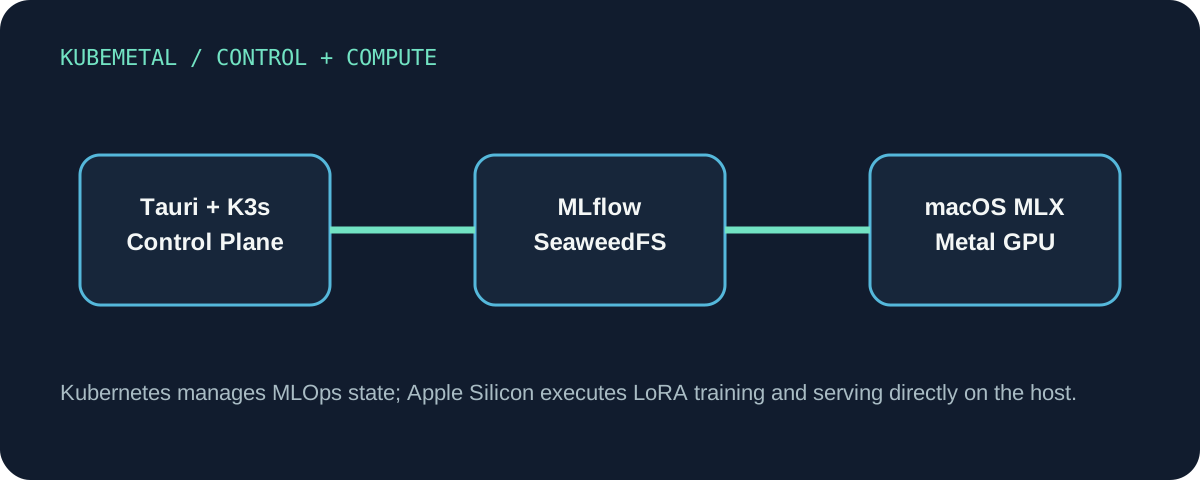
Its defining architecture is control/compute separation: Kubernetes remains the control-plane environment for services such as MLflow and SeaweedFS, while GPU-bound MLX workloads execute directly on the macOS host where Apple Silicon Metal and Unified Memory are available.
User Workspaces
| Tab | Purpose |
|---|---|
| Dashboard | RAM/CPU, Colima lifecycle, MLOps provisioning, port forwarding |
| kagent Ops | Agent-based diagnostics and AI-assisted operations for external clusters |
| Pipeline | End-to-end model workflow visualization |
| Model Hub | Hugging Face search, host download, SeaweedFS upload, MLflow registration |
| MLX Studio | Host MLX environment, LoRA fine-tuning, model serving |
| Data | Ingestion DAGs, chunking, LanceDB RAG, SeaweedFS backup, DVC |
| Access Console | Service access and health checks |
| Air-Gap Management | Offline bundle installation and asset verification |
External Cluster Integration
The default D30 path is agent-only. The external Kubernetes cluster remains separate from KubeMetal's local MLOps stack and is connected for diagnostics and operations rather than being re-provisioned.
A full-stack D26 external deployment path is opt-in and performs preflight checks for kubeconfig context, storage class, Kyverno enforcement, Argo CD ownership, and verified host-bridge reachability before applying manifests.
macOS Security Boundary
Because KubeMetal is a desktop application that can access local networks and Kubernetes APIs, code signing and macOS permission identity are part of the runtime model. Ad-hoc signing can produce unstable permission identity across builds; a stable signing identity is required for repeatable LAN access and distribution.
Air-Gapped MLOps
Air-gap management covers bundles containing:
- container images
- Helm charts
- binaries
- asset versions
- verification metadata
This makes the project useful not only as a local ML launcher but as an edge/disconnected MLOps workstation control surface.
Measured Reference Performance
The repository documents packaged-app measurements from an Apple M4 Pro / 64GB system on 2026-07-27–28:
- VLM serving: 196–198 tok/s
- VLM TTFT: 442–767 ms
- LoRA fine-tuning: 674.5M trainable parameters, peak memory 8.7GB
- 64GB host profile: K8s VM around 12GB / 6 CPU
These values are hardware/model-specific references, not universal benchmarks. Their value is demonstrating the behavior of the hybrid architecture on real Apple Silicon hardware.
Development Environment
git clone https://github.com/dasomel/kubemetal.git
cd kubemetal
pnpm install
pnpm tauri devRequirements include macOS 14+, Apple Silicon, Homebrew, Colima, kubectl, Node 22+, pnpm, and Rust.
Current Development Scope
The repository README marks the core Phase 1–3 capabilities as complete, including Tauri/Colima lifecycle, MLflow/SeaweedFS provisioning, Model Hub, host MLX fine-tuning, serving, pipeline visualization, packaged app output, and resource/thermal guardrails.
Subsequent work continues around external-cluster integration, signing, GitOps boundaries, and real-world operational constraints.
Documentation Index
| Topic | Document | Purpose |
|---|---|---|
| Overview | KubeMetal Overview | Product scope and architecture |
| Architecture | System Architecture | Tauri ↔ K3s ↔ host MLX boundaries |
| MLOps | MLOps Pipelines | Model lifecycle and fine-tuning |
| Integration | External Cluster Integration | D30/D26 integration paths |
| Usage | Usage Guide | End-user workflow |
| Operations | Operations | Signing, guardrails, troubleshooting |