

Project Overview
NFS Quota Agent closes the gap between Kubernetes storage objects and the filesystem that actually stores NFS data.
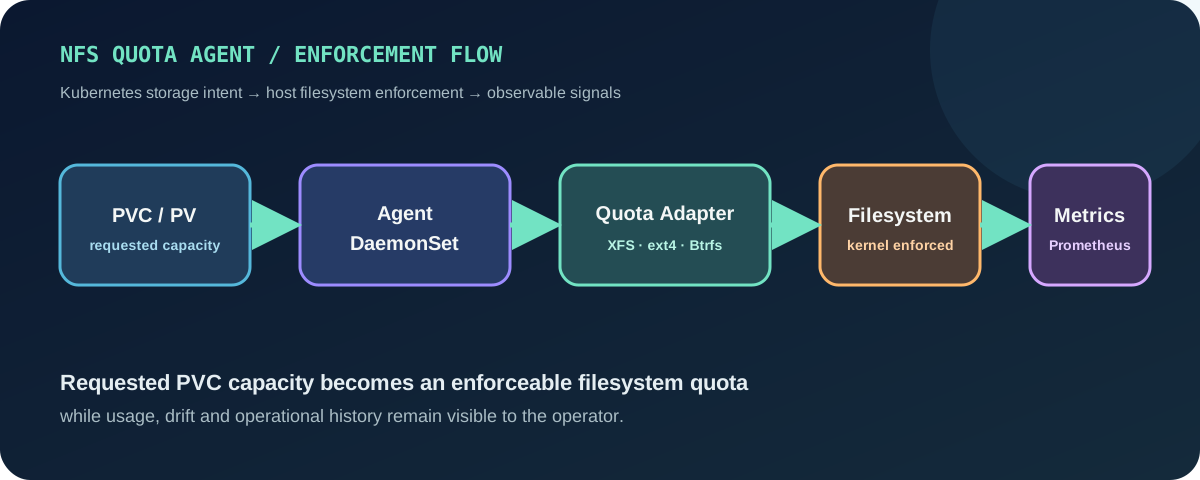
A PVC may request 10Gi, but a normal NFS provisioner does not automatically turn that request into a hard limit on the NFS server directory. The agent watches NFS PersistentVolumes, maps them to their local export paths, and applies the appropriate filesystem quota.
This makes it a Kubernetes + Linux filesystem enforcement component, not merely another storage controller.
Core Flow
The agent supports native NFS PVs and CSI NFS PVs, including path mapping based on NFS share/subdirectory metadata.
Filesystem Support
| Filesystem | Mechanism | Mount option | Min kernel | Notes |
|---|---|---|---|---|
| XFS | xfs_quota / project quota | prjquota | 2.6+ | Primary use case |
| ext4 | setquota + project attribute | prjquota | 4.5+ (e2fsprogs 1.43+) | Linux project quota support |
| Btrfs | qgroup quota (btrfs quota enable) | not needed | 3.4+ | Target directory must be a subvolume — the agent errors out otherwise |
ext4 security limitation: ext4 project quota hard limits are not enforced for a writer holding
CAP_SYS_RESOURCE(root) — the kernel'signore_hardlimit()(fs/quota/dquot.c) waives the limit outright. Over NFS withno_root_squash,knfsdwrites with credentials mapped from the client, so a root-owned tenant workload can silently bypass its ext4 quota. XFS and Btrfs enforce their limits regardless of the writer's privilege. For ext4 exports, useroot_squash(the default) and run tenant workloads as non-root, or prefer XFS/Btrfs where root-owned or untrusted workloads are expected.
Kubernetes Deployment Model
The agent runs as a DaemonSet on the NFS server node because quota operations must target the local filesystem rather than an NFS client mount.
This creates a larger privilege boundary than a normal Kubernetes controller, so node placement and hostPath scope are part of the security design.
Operational Features
The project includes optional operational capabilities around the core enforcement engine:
- Prometheus metrics / ServiceMonitor, Grafana dashboard ConfigMap
- PrometheusRule alerts
events.k8s.io/v1Kubernetes Events + retry metrics (opt-in, comes with an RBAC widening)- audit logging
- usage history
- orphan cleanup with dry-run support
- namespace quota policy (advisory) plus a
QuotaPolicyCRD for declarative enforcement - optional web UI
- optional NetworkPolicy template
- air-gapped (offline bundle) install with cosign signature verification
- configurable sync interval
- Helm-based deployment and rolling upgrades
Storage Policy
When policy support is enabled, Kubernetes-native resources can be used to express quota defaults and limits. This keeps storage governance close to the existing Kubernetes resource model instead of inventing a completely separate configuration language. This advisory policy view is informational only and does not change actual quota sizing — the QuotaPolicy CRD below is what actually enforces limits.
Helm Values (selected)
| Key | Default | Description |
|---|---|---|
image.digest | "" | Pin the image by digest for air-gap installs (overrides tag when set) |
config.provisionerName | nfs.csi.k8s.io | Provisioner to filter |
config.processAllNFS | false | Process all NFS PVs regardless of provisioner |
config.syncInterval | 30s | Quota sync interval |
webUI.enabled | false | Enable the web UI dashboard |
cleanup.enabled / cleanup.dryRun | false / true | Auto orphan cleanup, dry-run by default |
policy.enabled | false | Advisory namespace quota policy/violations views in the web UI (informational only) |
quotaPolicy.enabled / quotaPolicy.singleWriter | false / false | Enable QuotaPolicy CRD enforcement; designate the single writer responsible for status write-back |
events.enabled | false | Emit per-PV quota outcomes as Kubernetes Events (widens RBAC — review before enabling on multi-tenant clusters) |
dashboard.enabled | false | Deploy the Grafana dashboard ConfigMap |
networkPolicy.enabled | false | Enable the NetworkPolicy template |
nodeSelector | nfs-server: "true" | Must not be empty — rejected at render time |
updateStrategy.rollingUpdate.maxUnavailable | 1 | Nodes updated concurrently during a rolling update |
See charts/nfs-quota-agent/values.yaml in the repository for the full list.
QuotaPolicy CRD (declarative filesystem quota policy)
QuotaPolicy (quota.nfs.io/v1alpha1, disabled by default) declares filesystem quota bounds as a Kubernetes object instead of relying only on each PVC's requested capacity. It layers on top of ResourceQuota/LimitRange rather than replacing them.
# Every PVC in "team-a" gets a 5Gi default, hard-capped at 20Gi via enforceMax
apiVersion: quota.nfs.io/v1alpha1
kind: QuotaPolicy
metadata:
  name: team-a-default
  namespace: team-a
spec:
  selector: {}
  priority: 100
  defaultQuota: 5Gi
  maxQuota: 20Gi
enforceMax: trueselector supports pvcName (most specific, wins regardless of priority), labelSelector, and storageClassNames (read only from the bound PV's spec, ANDed with other selectors). status.conditions reports Ready, Applied, Degraded, Drifted, LimitRangeConflict, and StorageClassBinding.
CLI Commands
nfs-quota-agent run --nfs-base-path=/export --provisioner-name=nfs.csi.k8s.io   # run the agent (default)
nfs-quota-agent status --path=/data                                             # quota/usage status
nfs-quota-agent top --path=/data -n 10 --watch                                  # top directories by usage
nfs-quota-agent report --path=/data --format=json|yaml|csv                      # generate a report
nfs-quota-agent cleanup --path=/data --kubeconfig=~/.kube/config [--dry-run=false] [--force]
nfs-quota-agent ui --path=/data --addr=:8080 # web UIPrometheus Metrics
:9090/metrics exposes nfs_disk_total_bytes, nfs_disk_used_bytes, nfs_disk_available_bytes, per-directory nfs_quota_used_bytes / nfs_quota_limit_bytes / nfs_quota_used_percent, and summary counters nfs_quota_directories_total, nfs_quota_warning_count, nfs_quota_exceeded_count.
Safety Boundaries
Because the agent changes real filesystem state:
- schedule only on intended NFS server nodes
- restrict hostPath to the actual export
- keep destructive cleanup disabled or dry-run by default
- expose quota state through annotations and metrics
- review host access changes during Helm upgrades
Getting Started
git clone https://github.com/dasomel/nfs-quota-agent.git
cd nfs-quota-agent
make buildDeploy to Kubernetes:
kubectl label node <nfs-server-node> nfs-server=true
helm install nfs-quota-agent ./charts/nfs-quota-agent \
--namespace nfs-quota-agent --create-namespaceEvery tagged release also publishes nfs-quota-agent-<version>-offline.tar.gz for clusters with zero outbound network access (multi-arch image OCI archive + Helm chart + hack/verify-release.py + compatibility matrix), and both the manifest and the bundle are cosign-signed.
Current Status
The latest release is v0.5.0 (2026-09-22), and the project is at Beta. Core quota enforcement for XFS, ext4, and Btrfs is complete and exercised against real kernels in CI, and releases are signed and reproducible — but the QuotaPolicy CRD is still v1alpha1 and may change incompatibly before v1.0, so production use should pin a chart version.
- v0.5.0: Grafana dashboard ConfigMap and a metric-name lint,
events.k8s.io/v1Events plus retry metrics (events.enabled), an opt-in NetworkPolicy template, fixes to ext4 repquota project-selector resolution and validation, a real-kernel ext4/btrfs quota-enforcement E2E matrix, an OpenSSF Scorecard workflow, and Trivy image scanning. - v0.4.0–v0.4.3: focused on stabilizing release signing — v0.4.0 shipped as a partial release because cosign failed to log in to GHCR when signing the Helm chart OCI artifact (the container image, binaries, and SBOMs published fine, but signatures,
release-manifest.json, and the offline bundle did not), and v0.4.1–v0.4.3 fixed the login and stabilized egress-block mode into a complete release.
Documentation Index
| Topic | Document | Purpose |
|---|---|---|
| Overview | Agent Overview | Problem and enforcement model |
| Architecture | Storage Architecture | PV mapping and quota execution |
| Feature Guide | Features | Filesystems, policies, metrics |
| Getting Started | Installation & Setup | Helm and host preparation |
| Features | Feature Details | Optional operational features |
| Operations | Operations & Monitoring | Monitoring, cleanup, troubleshooting |
| Web UI | Web UI | Storage administration surface |