Project Overview
Beluga is a self-hosted, learning-scale modern data platform for reproducing the end-to-end data lifecycle on local Kubernetes.
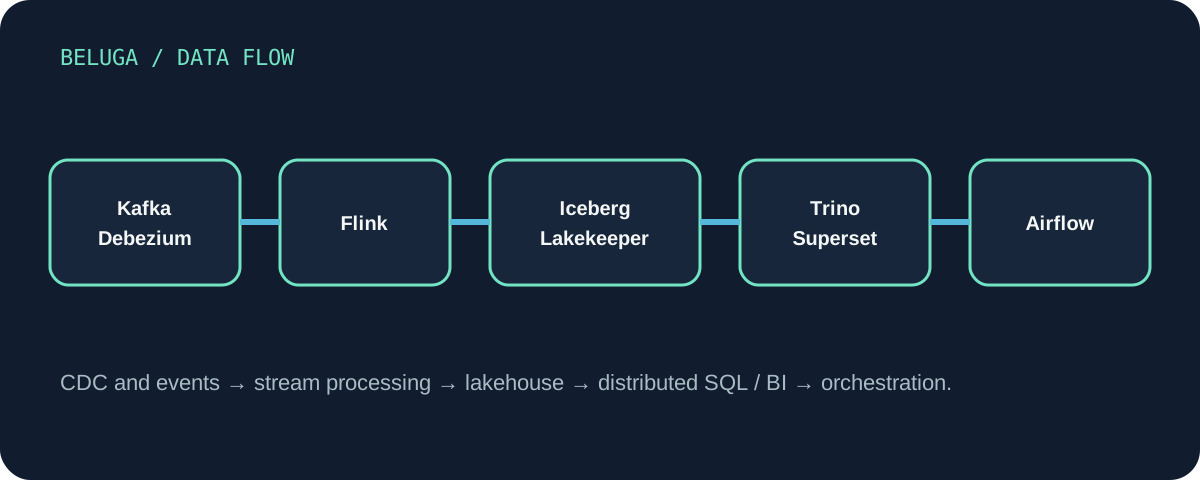
It intentionally focuses on integration evidence, not production-scale infrastructure. The platform demonstrates how CDC, streaming, stream processing, lakehouse storage, SQL analytics, BI, and orchestration can work together under one GitOps-managed environment.
Platform Components
| Area | Components | Role |
|---|---|---|
| Cluster | k3s, Cilium, MetalLB | Local Kubernetes base |
| Gateway | APISIX, etcd | HTTP entrypoint |
| GitOps | Argo CD | App-of-Apps deployment |
| Identity | Keycloak, OpenLDAP | Authentication and groups |
| Policy | OPA, OpenFGA | Policy and authorization |
| Streaming | Strimzi Kafka, Debezium | Events and CDC |
| Processing | Flink Kubernetes Operator | Stateful stream processing |
| Catalog | Lakekeeper | Iceberg REST catalog |
| Storage | SeaweedFS | S3-compatible object storage |
| Database | CloudNativePG | PostgreSQL source and metadata |
| Query | Trino | Distributed SQL over Iceberg |
| BI | Superset | Analytics and dashboards |
| Orchestration | Airflow 3 | DAG-based workflows |
| Optional governance | OpenMetadata, OpenSearch | Catalog and lineage |
| Observability | Prometheus Stack | Platform metrics |
Integration Model
The platform is split into beluga-platform and beluga-data Helm layers, both deployed through Argo CD. This keeps platform services and data workloads independently understandable while maintaining a single bootstrap path.
Two real data demonstrations provide validation:
- Synthetic clickstream — generated events through streaming and lakehouse processing
- PostgreSQL CDC — source DB changes captured by Debezium and processed into the lakehouse
Architecture
Local Resource Profile
Beluga is not a tiny demo. It provisions four VMs and a full data stack.
- 32GB host RAM minimum
- 48GB+ enables larger profiles and OpenMetadata/Trino workers
- 64GB+ adds further worker memory
- VMware Fusion on ARM64 or VirtualBox on AMD64
- profile selection is based on detected host resources
This makes Beluga a reference environment for studying the integration cost of a complete data platform, rather than a lightweight sample app.
Verification
The repository deliberately separates rendering from real runtime verification:
The scripts inspect real cluster/API state instead of treating successful Helm rendering as proof of a working platform.
Security and Credentials
Passwords are not committed to the repository. Bootstrap generates credentials and stores them in Kubernetes Secrets, while Helm values use placeholders/references rather than static credentials.
The repository also keeps policy declarations under policies/ so identity, authorization, and database policy generation can remain aligned.
Current Status
Beluga is a personal / learning-scale reference platform.
- Core Kafka/CDC → Flink → Iceberg → Trino/Superset/Airflow flow is implemented toward clean-install E2E validation.
- The local cluster is not continuously running, so not every latest change has live-cluster validation.
- Governance/policy compiler integration continues as a separate evolution area.
Getting Started
git clone https://github.com/dasomel/beluga.git
cd beluga
make up
make status
make testDocumentation Index
| Topic | Document | Purpose |
|---|---|---|
| Overview | Platform Overview | Scope and product model |
| Architecture | Pipeline Architecture | Component boundaries and data flow |
| Getting Started | Cluster Setup | VM → k3s → GitOps bootstrap |
| Operations | Data Operations | Lifecycle and operational runbooks |
| Troubleshooting | Troubleshooting | Cluster, Kafka, Flink, and query issues |