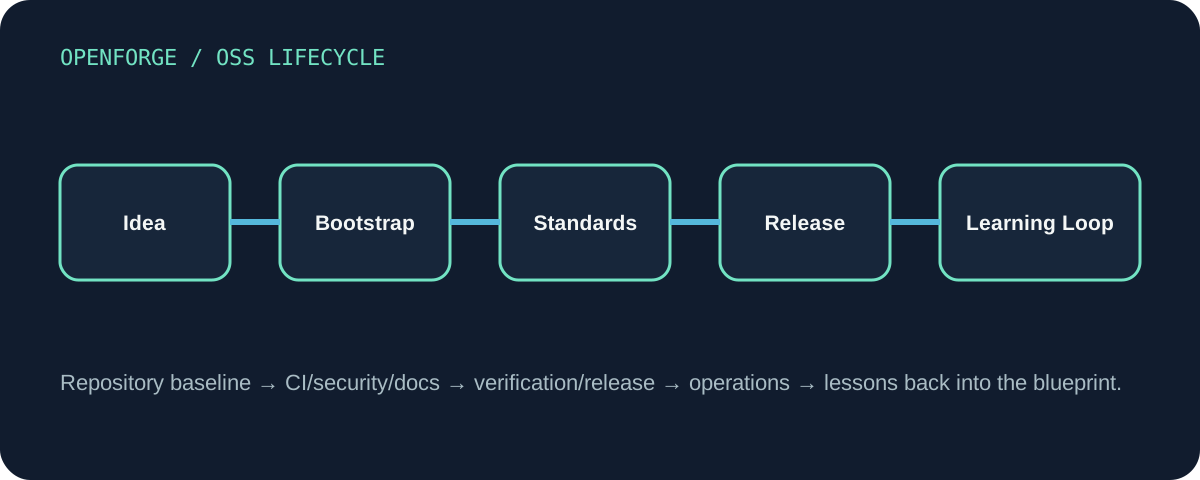
Project Overview
OpenForge started as a reusable OSS project blueprint and now acts as a Blueprint + Engineering Standards + Evidence-driven Operating Model + Portfolio Control Plane for governing the engineering state of multiple open-source projects.
This page deliberately avoids copying fast-aging counts such as the number of standards or template categories. The source of truth for the current standards, templates, ADRs, and portfolio state is the OpenForge GitHub repository and its canonical registries.
Engineering Operating Model
The umbrella lifecycle is:
Intent
  ↓
Constraints / Repository Context
  ↓
Human or Agent Implementation
  ↓
Executable Checks
  ↓
Evidence
  ↓
Human Review / Stewardship
  ↓
Release / Rollback
  ↓
Observe / Learn / ImproveThe key rule is that generated or merged code is not completion by itself. A change is complete only when intended behavior exists at the relevant boundary, appropriate verification has passed, evidence is retained, and release/recovery implications are understood.
Implemented Shared Controls
Executable engineering governance
OpenForge separates declarative rules, executable rules, and judgment. Deterministic requirements should have an executable owner—formatter/linter, test, schema/policy validator, or CI gate—while architecture fit and maintainability remain human-review concerns instead of being reduced to false-green automation.
Revision-bound agent/portfolio audits detect when repository instructions claim a deterministic rule without a corresponding executable owner. The audit's swallowed_failure_detector also catches validators whose failures are unconditionally discarded and echo-branch false-greens that fake success with an echo statement instead of a real check.
Risk-Scaled Change Packages
Class C/D changes, and complex Class B changes, first go through a short-lived, review-gated Change Package before broad implementation. The Change Package captures requirements, acceptance scenarios, task traceability, and a verification plan, and is treated as a document with an intentionally short lifecycle once the change lands.
Executable Maturity Assessment (Rust CLI)
OpenForge does not leave its standards as documentation only. It ships a standalone Rust CLI (openforge, Rust 2024 edition) that converts them into deterministic, evidence-based assessment results.
openforge assess . --format json
openforge assess . --run-execution --format json
openforge assess . --runtime --kube-context my-cluster --format json
openforge compare baseline.json current.json --fail-on-regressionThe assessment layers are intentionally separated:
- L1 Repository — documentation, governance, security, CI/CD, release, platform and web-asset source evidence
- L2 Execution — trusted built-in build/test/lint probes for supported ecosystems
- L3 Runtime — read-only Kubernetes evidence for availability, policy coverage, RBAC/security, storage/CSI, certificates, backup/restore, observability and GitOps
- Web runtime evidence — explicit opt-in checks for immutable cache policy (
WEB-008) and observable cache effectiveness (WEB-009) - Optional AI analysis — AI may interpret a completed report, but never changes deterministic scores, PASS/FAIL status, or collected evidence
Profiles, applicability, time-bounded waivers, baselines, and comparison/regression gates are supported so unlike projects are not forced into the same scoring scope.
Experimental Agent Harness Evaluation
The same model can behave differently when a coding harness changes its initial instructions, tool schemas, context management, retry behavior, or execution loop. OpenForge provides an experimental, non-normative harness dataset schema (openforge-agent-harness-dataset/v1), a neutral comparison CLI, and a bilingual pilot protocol for this. The profile does not recommend a default harness or provider, and only allows comparisons within a controlled cohort that fixes task, revision, provider, OS, and tool profile.
Agent Execution Security
When an AI/agent can call tools or reach Kubernetes, hosts, directories, filesystems, or other side-effecting systems, repository instructions are not treated as an authorization boundary.
The shared lifecycle is:
resolve concrete invocation once
  → validate / authorize
  → attenuate authority
  → exact approval when required
  → runtime revalidation
  → enforce / execute
  → post-state verification
→ recomputable evidenceProfiles have been applied at real or future execution boundaries including Narwhal Portal node Auto-Fix, KubeMetal's future L3 contract, Beluga's read-only Operations Agent, and kube-ready-box sandbox enforcement evidence.
Portfolio Control Plane
OpenForge does not infer completion from GitHub activity alone.
Downstream implementation
        ↓
CI / verification
        ↓
project status payload
        ↓
OpenForge status PR
        ↓
validation + merge
        ↓
canonical portfolio state
        ↓
/oss dashboardThe dashboard represents development/adoption, project relationships and impact, milestones, and maintenance intelligence such as lifecycle stage, blast radius, review cadence, and exit-path readiness.
The canonical portfolio state under portfolio/ is structured as projects.json, relationships.json, milestones.json, maintenance.json, capability-ownership.json, agent-audit.json, and legacy-evidence-catalog.json. Siqoq is registered in this registry as well, with category: Physical AI / Edge AI, role: experiment, and development_status: active — showing that portfolio governance applies the same evidence contract to early-stage experimental projects, not only infrastructure projects like kube-ready-box.
A separate Python-based compliance audit engine, templates/scripts/audit-portfolio.py, generates reproducible scorecards, delta comparisons, and actionable GitHub gap issues against the shared engineering standards. The current Portfolio Scorecard tracks adoption across 14 repositories, and Reference Metrics tracks 35 standard engineering/maturity metrics.
Documentation Freshness
User capabilities, architecture, security boundaries, and runtime/platform support are part of the engineering evidence chain.
- distinguish
planned,experimental,implemented, anddeprecated - bind implementation-status snapshots to the current default branch
- never use unit/mock evidence to overstate real cluster/filesystem/runtime behavior
- treat upstream OSS repositories as the source of truth for blog/project pages
Maka / Multi-model Runtime Direction
Apache Maka's Runtime Host, durable Event Log, permission boundary, Agent Graph, and declarative Eval architecture contain useful patterns for OpenForge. OpenForge currently partially adopts those architectural patterns while keeping Maka optional rather than a mandatory runtime dependency.
Any future multi-model comparison should freeze repository revision, task, budget, and verifier across arms. OpenForge does not automate around provider login or credential controls merely to satisfy a benchmark checkbox.
Current Role
OpenForge does not take implementation ownership away from downstream projects. Each repository owns its code and runtime evidence; OpenForge provides shared boundaries for:
- recording engineering intent and constraints
- repeatable build/test/security/release baselines
- evidence and convergence contracts for human/agent work
- cross-project status publication and portfolio governance
- maintenance lifecycle, ownership, and exit-path review
The goal is not to make every project identical. It is to preserve product identity and implementation freedom while making common engineering invariants verifiable.